

Inside a Dubai Real Estate CRM Infrastructure Assessment

Executive Context
During a recent operational discovery process involving a Dubai-based luxury real estate environment, Diamond Litchi conducted a strategic assessment around lead management, communication workflows, CRM infrastructure, listing synchronization, and operational scalability.
The objective was not simply to evaluate a CRM platform.
The objective was to understand how operational fragmentation inside modern luxury real estate environments quietly affects:
- lead conversion,
- response time,
- productivity,
- agent efficiency,
- follow-through,
- and long-term revenue scalability.
What became immediately visible was not a software problem.
It was an operational infrastructure problem.
Situation: What Was Visible
The environment revealed several operational patterns commonly found inside fast-moving real estate teams:
- leads arriving from multiple portals and communication channels
- fragmented communication environments
- manual lead handling processes
- disconnected operational systems
- inconsistent follow-up visibility
- dependency on administrative intervention
- limited centralized operational oversight
- reduced workflow continuity between agents and management.
The lead environment included platforms such as:
- Bayut
- Property Finder
- Meta platforms
- WhatsApp communication
- website inquiries.
The operational challenge was not lead generation.
The challenge was operational coordination after lead generation.
The Hidden Operational Cost
At first glance, fragmented workflows may appear manageable.
However, operational fragmentation creates commercial consequences that compound over time.
These include:
- delayed response cycles
- missed follow-ups
- duplicated administrative effort
- inconsistent client communication
- reduced accountability
- agent fatigue
- lead leakage
- reduced conversion consistency
- limited scalability.
In luxury real estate environments, where speed, trust, and responsiveness heavily influence conversion, operational delays quietly become revenue leakage.
The Real Problem Was Not the CRM
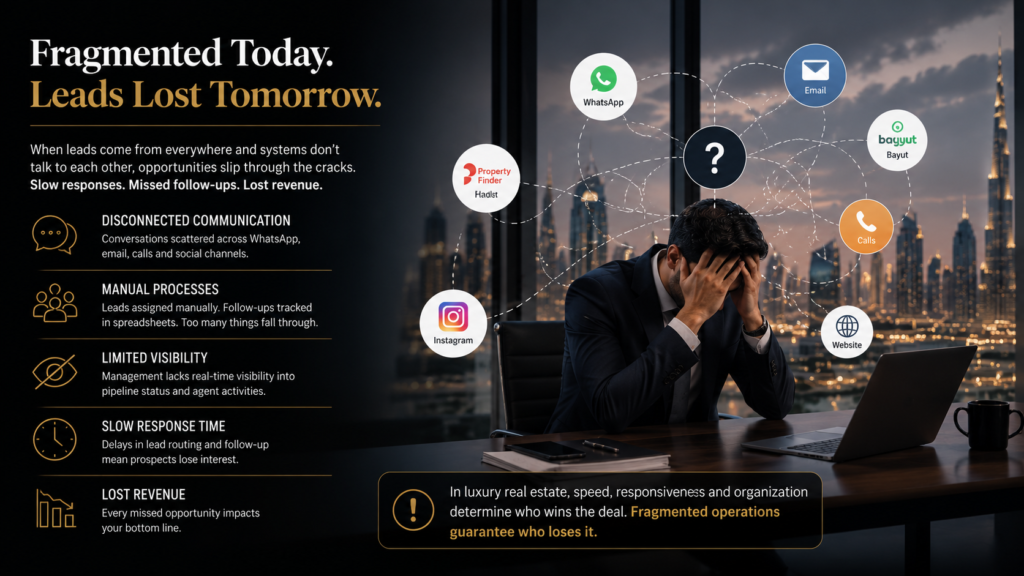
One of the most common misconceptions within real estate operations is assuming the CRM itself is the primary problem.
In reality, the issue is often the absence of a connected operational environment.
Most teams are not struggling because they lack software.
They are struggling because:
- communication systems are disconnected
- workflows are fragmented
- portal environments operate separately
- follow-up structures are inconsistent
- operational visibility is limited.
This creates operational friction across the entire sales process.
Communication Fragmentation
One of the most significant operational observations involved communication handling.
The environment depended heavily on WhatsApp communication between agents and prospective buyers.
However:
- conversations were not centralized operationally
- assignment structures were inconsistent
- visibility across lead flow was limited
- communication continuity depended heavily on manual coordination.
This creates risk inside growing real estate environments because lead ownership, accountability, and operational visibility become difficult to manage at scale.
The Operational Infrastructure Approach
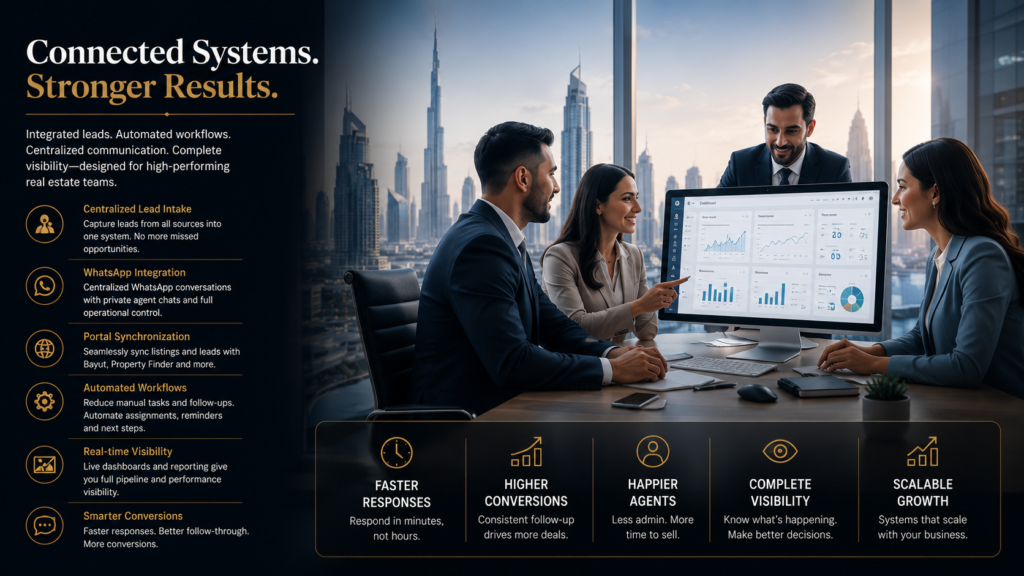
The proposed infrastructure approach focused on transforming fragmented workflows into one centralized operating environment.
The objective was to create:
- centralized lead intake
- structured lead routing
- synchronized communication
- operational visibility
- automation continuity
- scalable workflow management.
Rather than functioning as isolated software tools, the environment would operate as a connected operational ecosystem.
Centralized Lead Environment
The proposed operational structure included centralized lead capture from:
- Bayut
- Property Finder
- Meta platforms
- website forms
- additional connected inquiry channels.
This removes:
- manual lead transfer
- delayed assignment
- disconnected intake workflows
- administrative duplication.
The result is faster lead response and improved operational continuity.
WhatsApp Operational Infrastructure
A major operational requirement involved maintaining WhatsApp communication convenience while improving organizational control.
The proposed environment supported:
- centralized WhatsApp lead intake
- controlled lead assignment
- private agent-client communication
- operational routing visibility
- structured communication workflows.
An important operational observation was that agents did not require personal WhatsApp infrastructure to operate effectively within the system environment.
This reduces communication fragmentation while preserving workflow flexibility.
Listing Synchronization & Portal Integration
The operational structure also focused heavily on listing synchronization.
This included synchronization between:
- CRM environments
- Bayut
- Property Finder
- connected listing ecosystems.
The objective was to reduce:
- repetitive administrative work
- duplicate listing management
- disconnected property updates
- inconsistent portal information.
This transforms the CRM from a passive contact database into a centralized real estate operating environment.
Campaign & Nurturing Infrastructure
Another major operational gap involved lead nurturing and campaign continuity.
Many real estate environments rely heavily on immediate inquiry handling but lack structured re-engagement systems.
The proposed infrastructure supported:
- WhatsApp campaigns
- email campaigns
- automated nurturing workflows
- follow-up sequences
- re-engagement structures
- centralized campaign management.
This creates operational continuity beyond the initial inquiry stage.
Activity Management & Follow-Through
One of the strongest operational advantages within structured CRM environments is activity management discipline.
The proposed environment included:
- automated reminders
- scheduled follow-ups
- activity tracking
- task assignment
- calendar scheduling
- workflow prompts
- next-step operational enforcement.
This improves:
- accountability
- consistency
- lead follow-through
- operational visibility.
In fast-moving real estate environments, missed follow-ups often occur not because agents are careless, but because operational systems lack structured continuity mechanisms.
Commercial Interpretation
The operational consequences of fragmented systems are rarely visible immediately.
However, over time they influence:
- response speed
- client experience
- lead conversion
- operational fatigue
- scalability
- organizational efficiency
- revenue continuity.
When teams spend excessive time:
- manually handling leads
- switching between systems
- updating listings repeatedly
- coordinating communication manually
they lose time that should be invested into:
- selling
- nurturing
- relationship building
- and conversion activity.
Operational friction silently reduces commercial performance.
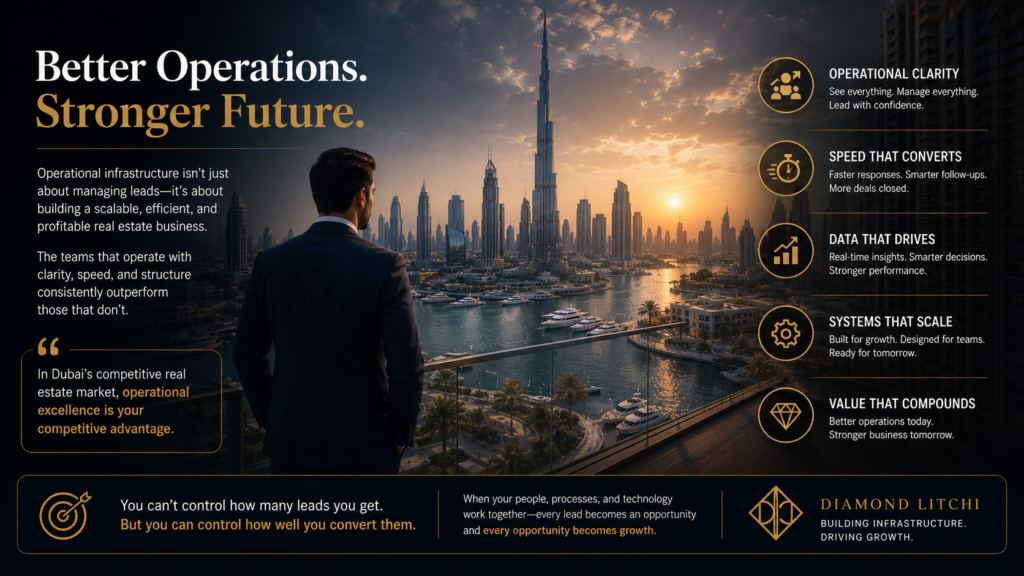
Key Strategic Insight
Modern luxury real estate environments do not simply need:
“a CRM.”
They need:
operational infrastructure.
The difference matters.
A CRM tool stores information.
Operational infrastructure coordinates:
- communication
- workflow
- lead management
- visibility
- accountability
- synchronization
- and operational continuity.
That distinction determines whether a system becomes:
- an expense,
or - a commercial growth environment.
Relevance to the Dubai Real Estate Market
Dubai’s luxury real estate environment operates at high speed and high expectation.
Buyers expect:
- rapid response
- professional communication
- operational consistency
- and seamless engagement.
As competition increases across:
- Bayut
- Property Finder
- Meta platforms
- and WhatsApp-driven inquiry environments,
operational infrastructure becomes increasingly important for maintaining conversion efficiency and organizational scalability.
Diamond Litchi’s Strategic Position
Diamond Litchi approaches CRM implementation differently.
The focus is not simply software deployment.
The focus is:
- operational infrastructure,
- workflow continuity,
- communication architecture,
- scalability,
- and commercial efficiency.
Technology alone rarely solves operational problems.
Connected systems, structured workflows, and operational alignment do.
Final Observation
The future of luxury real estate operations will not be determined only by:
- lead quantity,
- advertising spend,
- or portal visibility.
It will increasingly be determined by:
how efficiently organizations manage, route, nurture, and convert operational opportunities internally.
Because in modern real estate environments:
the companies that respond faster, operate cleaner, and maintain stronger operational continuity often gain the commercial advantage long before the sale is closed.