

Why This Matters to Growing Companies
Revenue Systems Engineering begins with a simple observation: many companies eventually reach a point where growth becomes harder to explain. Marketing activity increases. Advertising budgets expand. Reports multiply across dashboards and presentations. Yet leadership still struggles to answer a simple question:
What actually produced revenue?

For founders, CEOs, and CFOs, this uncertainty creates pressure. Marketing investments must be justified. Sales forecasts must be defended. Growth strategies must be explained to boards, investors, and teams.
When the relationship between marketing activity and revenue outcomes becomes unclear, confidence begins to erode. In many organisations, the instinctive response is to increase activity:
- more advertising
- more content
- more marketing tools
- more campaigns.
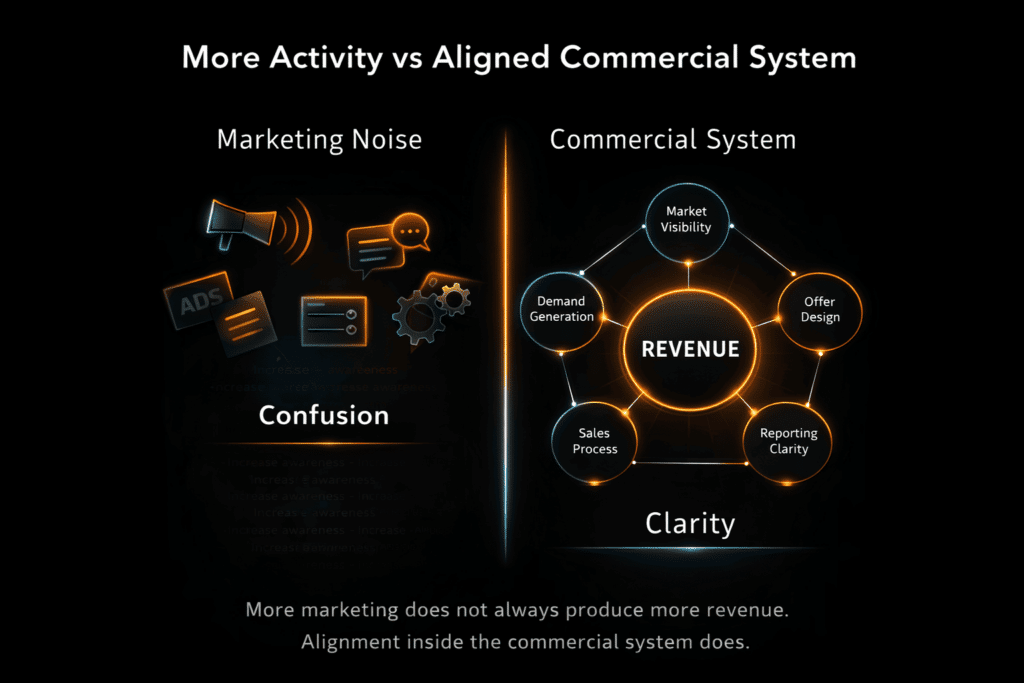
While these efforts may increase visibility, they do not always solve the underlying issue. Because in many cases, the challenge is not marketing activity itself. The challenge is that the commercial system responsible for generating revenue is misaligned.
Understanding this distinction is the starting point for a concept increasingly discussed in commercial strategy: Revenue Systems Engineering.
Understanding the Commercial System Behind Revenue Systems Engineering
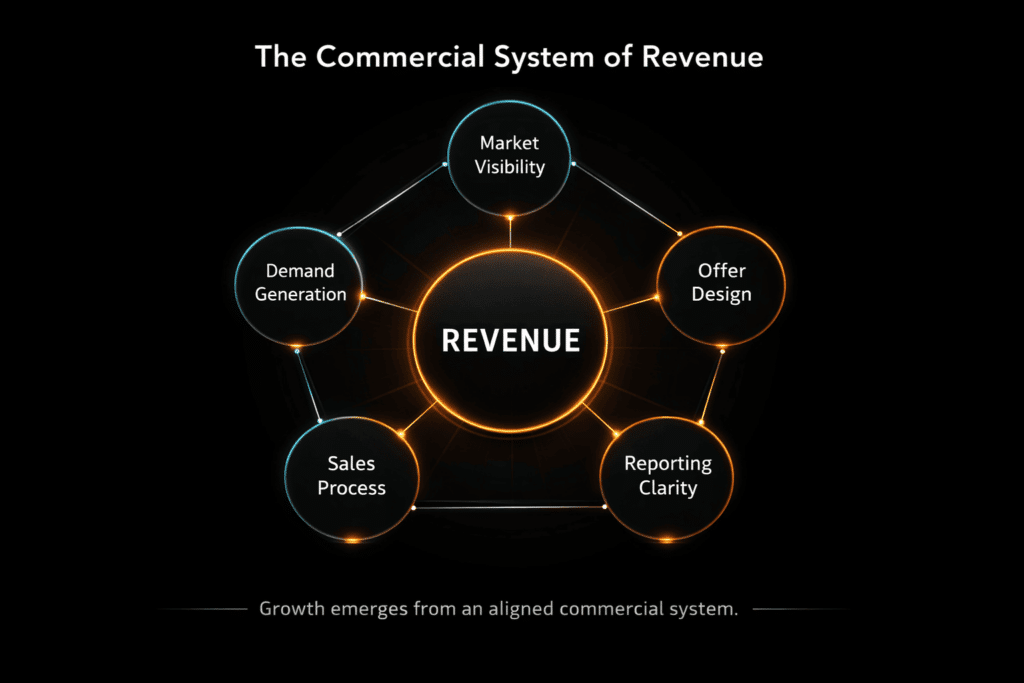
Revenue is rarely produced by a single function inside a company. It emerges from the interaction of several interconnected components that together form a commercial system. This perspective reflects principles found in Systems Thinking, a discipline that studies how interconnected parts of an organisation influence outcomes rather than operating independently.
These components typically include:
Market visibility
Whether the right audience is aware of the company and its offering.
Demand generation
Whether interest is being created among potential buyers.
Offer design
Whether the product or service communicates clear and compelling value.
Sales process
Whether opportunities are converted effectively once interest exists.
Reporting systems
Whether leadership can clearly identify what actions are producing results.
Each of these elements influences the others. Strong marketing visibility cannot compensate for an unclear offer. High demand cannot produce revenue if the sales process is ineffective. And even successful campaigns can appear unsuccessful when reporting systems fail to connect activity to outcomes.
When these elements function coherently, growth becomes easier to sustain. When they become misaligned, revenue becomes unpredictable.
What Revenue Systems Engineering Means
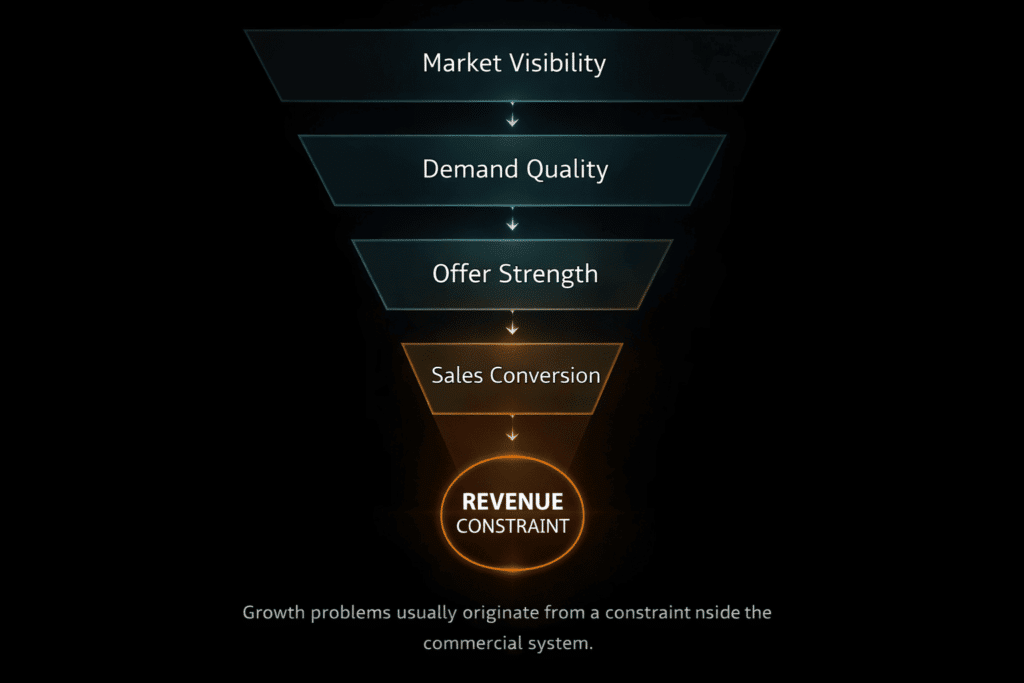
Revenue Systems Engineering approaches growth as the design and optimization of the entire commercial system rather than the management of individual marketing channels.
Instead of asking:
How can we increase marketing activity?
It asks a different question:
Which part of the commercial system is preventing growth?
By examining how the components of the system interact, organisations can identify the constraint that is limiting performance. This perspective changes how companies approach growth challenges.
Marketing is no longer viewed as the sole engine of revenue.
Instead, it becomes one lever within a broader commercial structure.
Why More Marketing Often Creates More Noise
When growth slows, many organisations respond by increasing marketing activity. New campaigns are launched. More platforms are tested. Additional tools are introduced.
However, if the commercial system itself is misaligned, these actions often produce limited results.
Advertising may increase awareness without attracting qualified demand.
Content may generate engagement without supporting a compelling offer.
Sales teams may receive leads that are difficult to convert.
The result is a growing volume of activity without corresponding clarity about outcomes. In this environment, reports become more complex while confidence in marketing investment declines.
Diagnosis Before Activity
Revenue Systems Engineering emphasizes diagnosis before action.
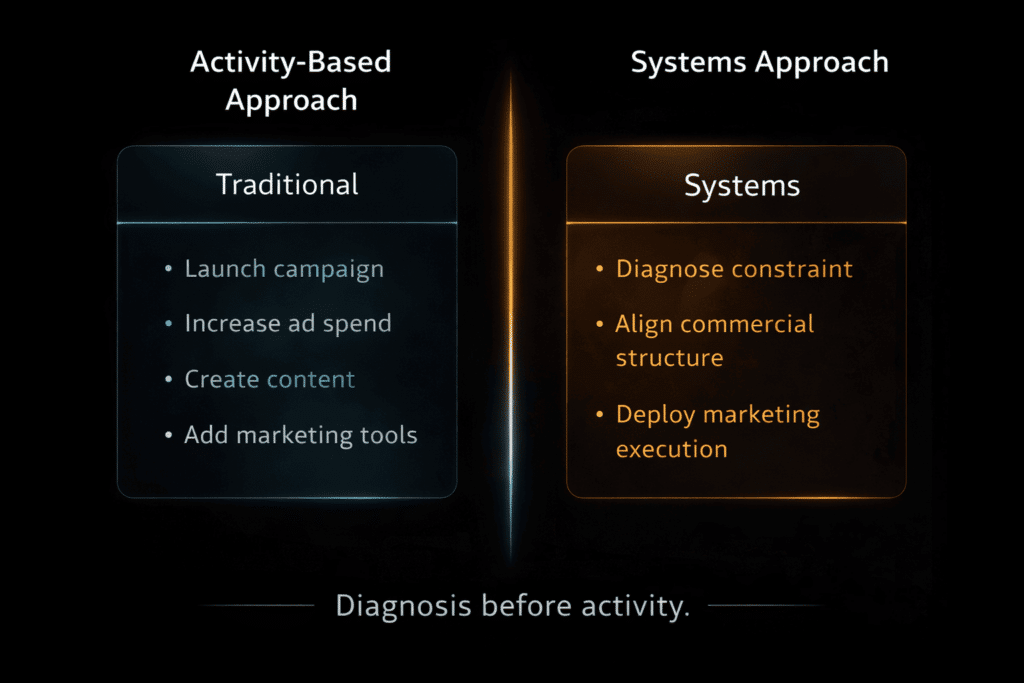
Before expanding marketing efforts, organisations first examine how the commercial system currently functions. This involves asking questions such as:
- Is the right audience being reached?
- Is demand being generated among potential buyers with real intent?
- Does the offer communicate clear value?
- Can the sales process convert interest into revenue effectively?
- Do leadership teams have clear reporting on what drives results?
By answering these questions, companies can identify where alignment is breaking down. Only then can marketing activity be directed toward the constraint that truly matters.
A Systems Approach to Sustainable Growth
Viewing revenue through the lens of a system changes how leadership teams think about growth. Instead of focusing on isolated tactics or marketing channels, organisations begin to examine how their entire commercial structure functions together.
This perspective often leads to clearer decisions about where to invest resources and how to structure growth strategies. Revenue Systems Engineering does not replace marketing.
It places marketing within the context of a broader commercial system — one where visibility, demand, offer strength, sales execution, and reporting clarity work together.
When that system is aligned, marketing activity stops being noise. It becomes a coordinated driver of sustainable revenue growth.
What Is Revenue Systems Engineering?
Why This Matters to Growing Companies
Many companies reach a point where growth becomes harder to explain. Marketing activity increases. Advertising budgets expand. Reports multiply across dashboards and presentations.
Yet leadership still struggles to answer a simple question:
What actually produced revenue?

For founders, CEOs, and CFOs, this uncertainty creates pressure. Marketing investments must be justified. Sales forecasts must be defended. Growth strategies must be explained to boards, investors, and teams.
When the relationship between marketing activity and revenue outcomes becomes unclear, confidence begins to erode. In many organisations, the instinctive response is to increase activity:
- more advertising
- more content
- more marketing tools
- more campaigns.
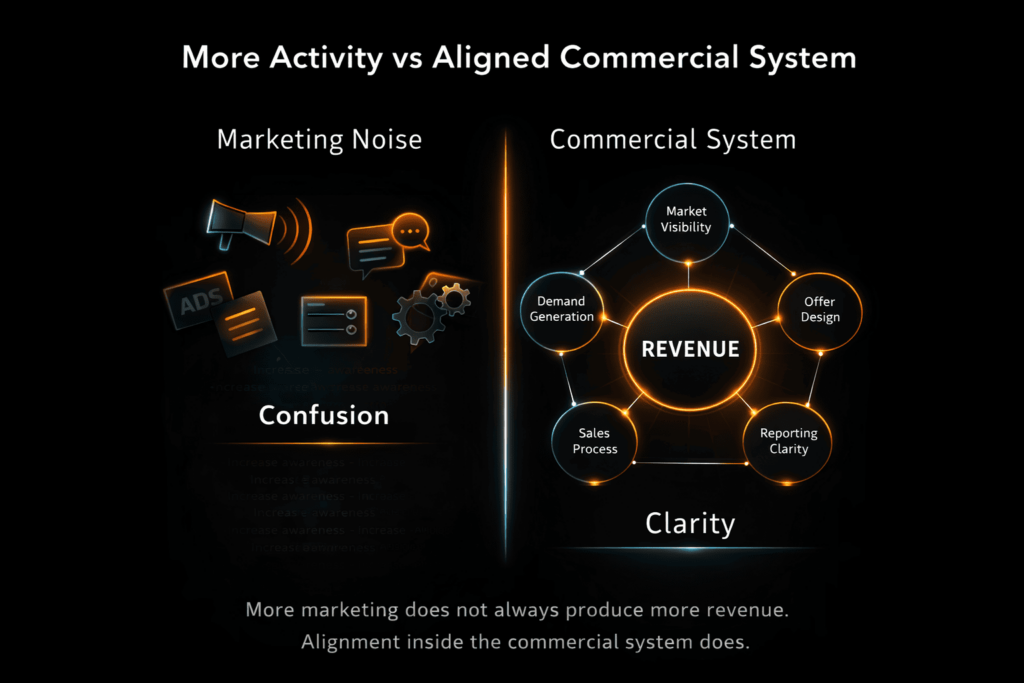
While these efforts may increase visibility, they do not always solve the underlying issue. Because in many cases, the challenge is not marketing activity itself. The challenge is that the commercial system responsible for generating revenue is misaligned.
Understanding this distinction is the starting point for a concept increasingly discussed in commercial strategy: Revenue Systems Engineering.
Understanding the Commercial System Behind Revenue
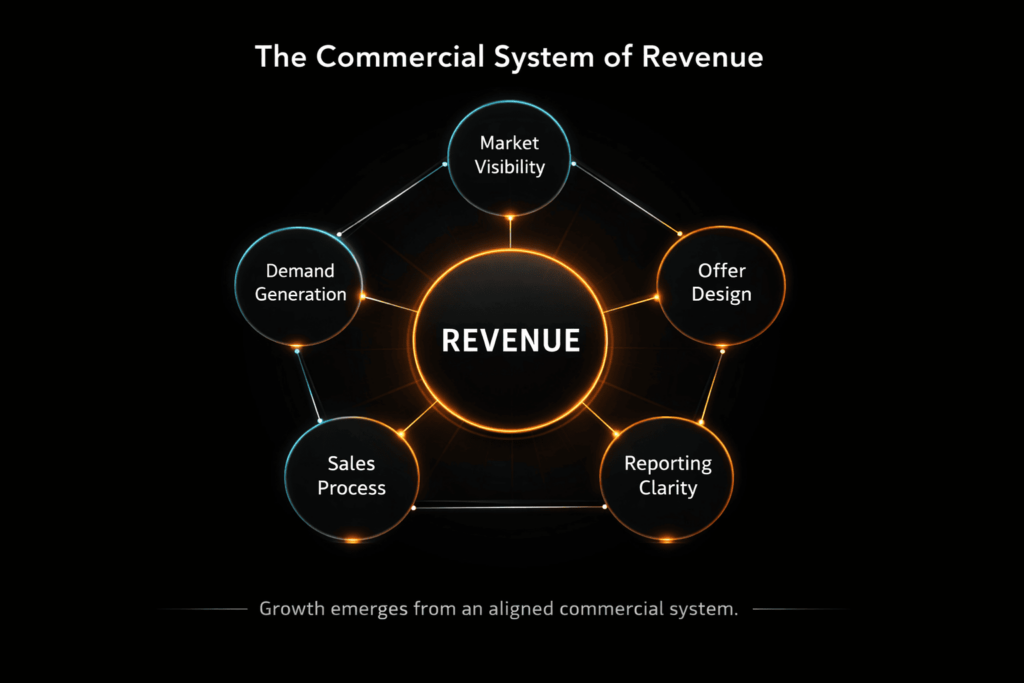
Revenue is rarely produced by a single function inside a company. It emerges from the interaction of several interconnected components that together form a commercial system.
These components typically include:
Market visibility
Whether the right audience is aware of the company and its offering.
Demand generation
Whether interest is being created among potential buyers.
Offer design
Whether the product or service communicates clear and compelling value.
Sales process
Whether opportunities are converted effectively once interest exists.
Reporting systems
Whether leadership can clearly identify what actions are producing results.
Each of these elements influences the others.
Strong marketing visibility cannot compensate for an unclear offer.
High demand cannot produce revenue if the sales process is ineffective.
And even successful campaigns can appear unsuccessful when reporting systems fail to connect activity to outcomes.
When these elements function coherently, growth becomes easier to sustain. When they become misaligned, revenue becomes unpredictable.
What Revenue Systems Engineering Means
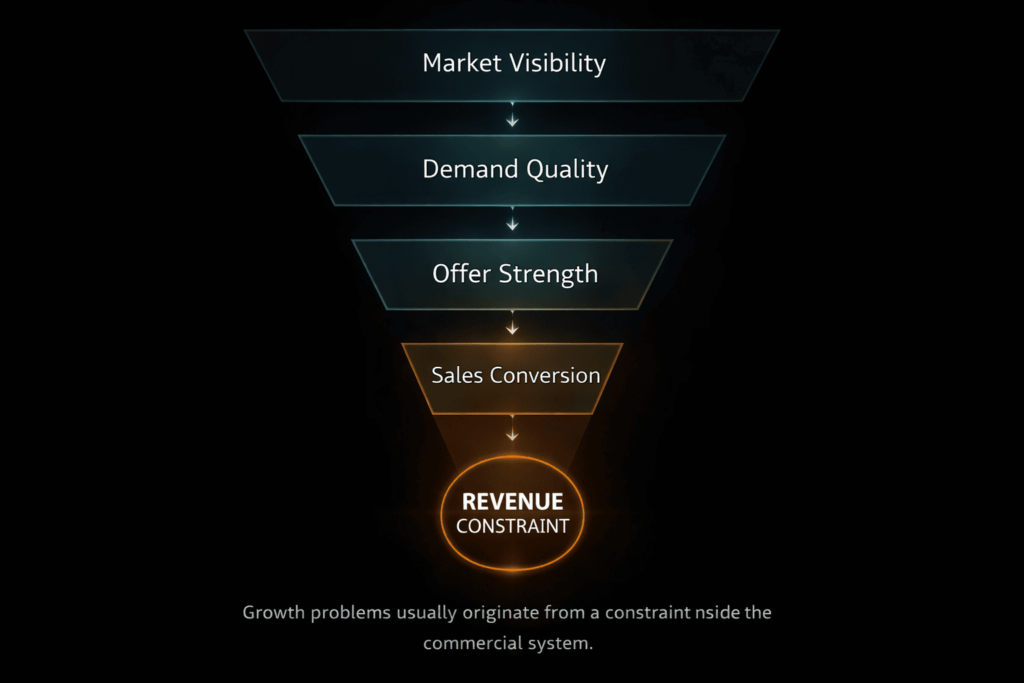
Revenue Systems Engineering approaches growth as the design and optimization of the entire commercial system rather than the management of individual marketing channels.
Instead of asking:
How can we increase marketing activity?
It asks a different question:
Which part of the commercial system is preventing growth?
By examining how the components of the system interact, organisations can identify the constraint that is limiting performance. This perspective changes how companies approach growth challenges.
Marketing is no longer viewed as the sole engine of revenue.
Instead, it becomes one lever within a broader commercial structure.
Why More Marketing Often Creates More Noise
When growth slows, many organisations respond by increasing marketing activity. New campaigns are launched. More platforms are tested. Additional tools are introduced.
However, if the commercial system itself is misaligned, these actions often produce limited results.
Advertising may increase awareness without attracting qualified demand.
Content may generate engagement without supporting a compelling offer.
Sales teams may receive leads that are difficult to convert.
The result is a growing volume of activity without corresponding clarity about outcomes. In this environment, reports become more complex while confidence in marketing investment declines.
Diagnosis Before Activity
Revenue Systems Engineering emphasizes diagnosis before action.
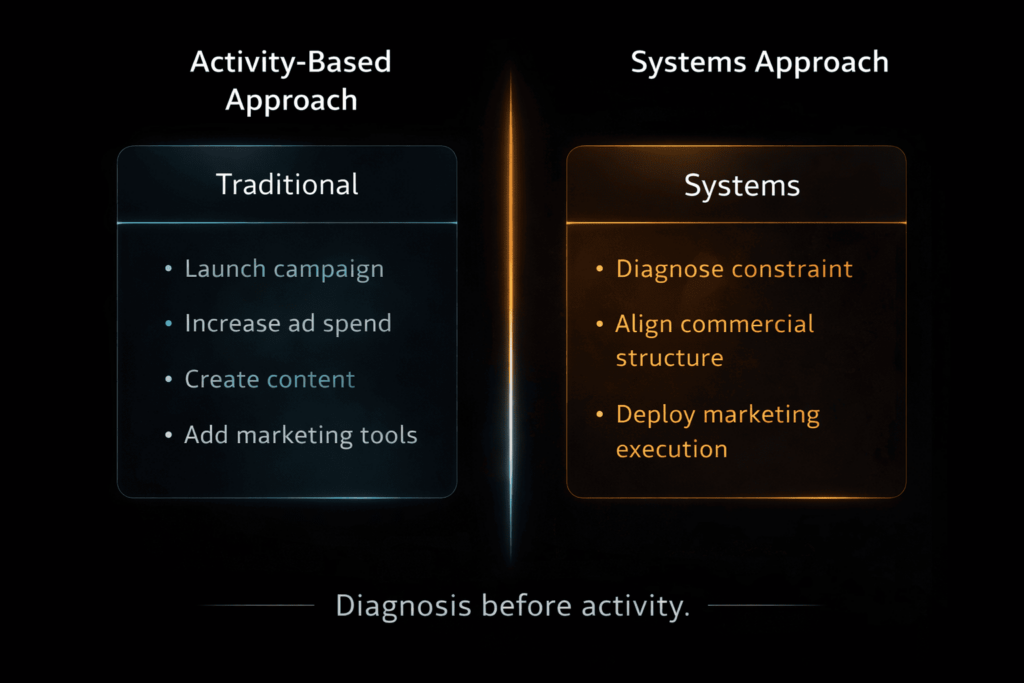
Before expanding marketing efforts, organisations first examine how the commercial system currently functions. This involves asking questions such as:
- Is the right audience being reached?
- Is demand being generated among potential buyers with real intent?
- Does the offer communicate clear value?
- Can the sales process convert interest into revenue effectively?
- Do leadership teams have clear reporting on what drives results?
By answering these questions, companies can identify where alignment is breaking down. Only then can marketing activity be directed toward the constraint that truly matters.
A Systems Approach to Sustainable Growth
Viewing revenue through the lens of a system changes how leadership teams think about growth. Instead of focusing on isolated tactics or marketing channels, organisations begin to examine how their entire commercial structure functions together.
This perspective often leads to clearer decisions about where to invest resources and how to structure growth strategies. Revenue Systems Engineering does not replace marketing.
It places marketing within the context of a broader commercial system — one where visibility, demand, offer strength, sales execution, and reporting clarity work together.
When that system is aligned, marketing activity stops being noise. It becomes a coordinated driver of sustainable revenue growth.
Frequently Asked Questions About Revenue Systems Engineering
- What exactly does Revenue Systems Engineering diagnose inside a company?
Revenue Systems Engineering examines how the commercial system responsible for growth actually functions.
Instead of evaluating marketing channels in isolation, it analyzes how several critical components interact:
- market visibility
- demand generation quality
- offer strength
- sales conversion structure
- reporting and attribution clarity.
When these elements operate in alignment, marketing investment becomes easier to defend and revenue growth becomes easier to sustain.
When they become misaligned, organisations often experience rising marketing activity without corresponding revenue clarity.
Revenue Systems Engineering focuses on identifying where the constraint inside the commercial system exists before additional marketing activity is deployed.
- When should a company consider Revenue Systems Engineering?
This approach becomes particularly valuable when leadership teams experience one or more of the following situations:
- growth is slowing despite ongoing marketing investment
- marketing reports are increasing but revenue attribution remains unclear
- leadership cannot confidently explain which activities are driving growth
- the company is preparing to scale into new markets.
Many organisations begin exploring Revenue Systems Engineering when annual revenue reaches the $5M–$50M stage, where growth complexity increases and marketing decisions require stronger justification.
- How is Revenue Systems Engineering different from hiring a marketing agency?
Traditional marketing services focus on executing campaigns or managing channels.
Revenue Systems Engineering focuses first on diagnosing the commercial structure behind growth.
This diagnostic approach examines how visibility, demand generation, offer design, sales execution, and reporting interact as a system.
Only after the constraint within that system is identified does marketing execution become strategically effective.
For many organisations, this shift from activity to diagnosis produces clearer decision-making and more defensible growth strategies.
- Which regions or companies typically qualify for this type of advisory work?
Revenue Systems Engineering is most commonly used by companies operating in competitive international markets where growth decisions carry significant financial implications.
Many of the organisations applying this approach operate in regions such as:
- the United States
- the United Arab Emirates
- the European Union
- South Africa and surrounding growth markets.
Companies expanding into these regions often require clearer commercial alignment to ensure marketing investment supports measurable revenue outcomes.
Organisations operating in or expanding toward these markets can explore region-specific diagnostic frameworks such as the Revenue Diagnostic for the USA, UAE, and European markets, which examine how local market dynamics influence the commercial system.
- What outcomes should leadership expect from a Revenue Systems Engineering diagnostic?
The goal is not simply to produce marketing recommendations.
The objective is to provide leadership teams with clarity about how their commercial system actually produces revenue. A structured diagnostic typically reveals:
- where the current growth constraint exists
- which elements of the commercial system require alignment
- which marketing activities should be expanded or reduced
- how growth investment can be justified with greater confidence.
For decision-makers responsible for defending marketing investment to boards, partners, or investors, this clarity often becomes as valuable as the growth strategies themselves.
Leaders interested in exploring how their commercial system currently performs often begin with a structured Revenue Diagnostic, which evaluates how visibility, demand generation, offer design, sales execution, and reporting clarity interact inside the organisation.